Back to Blog

Doji Candlestick Pattern: Types, Signals & Strategy | Stockart

Doji Candlestick Pattern

A Doji Candlestick Pattern is formed when the opening price and closing price of a stock or asset are almost the same. This pattern represents market indecision, where neither buyers nor sellers are in full control.

In technical analysis, Doji candles are considered one of the most important candlestick patterns because they can signal:

  • Trend reversal

  • Market uncertainty

  • Potential breakout

  • Balance between buyers and sellers

When a Doji appears after a strong uptrend or downtrend, traders often consider it a sign that the current trend may weaken or reverse.

What Does a Doji Candle Indicate?

A Doji candle shows that:

  • Buyers tried to push prices higher

  • Sellers tried to push prices lower

  • But finally, the price closed near the opening level

This creates a candle with a very small body and visible shadows.

The longer the shadows, the greater the market indecision.

Types of Doji Candlestick Patterns

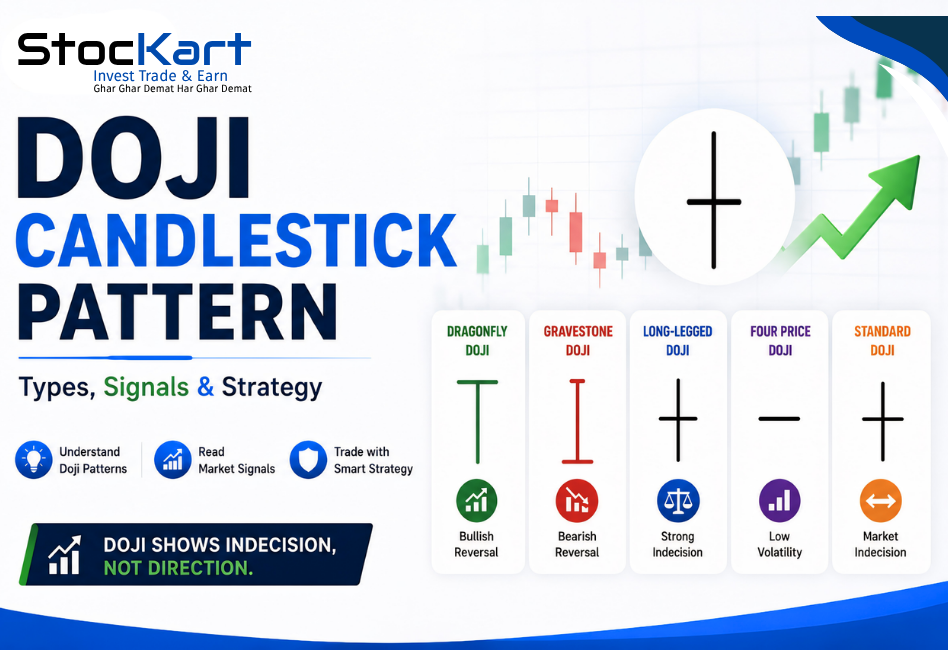
1. Standard Doji


The Standard Doji has small body with almost equal upper and lower shadows.

What It Indicates

  • Balance between buyers and sellers

  • Market indecision

  • Possible trend reversal

Trading Psychology

During the trading session:

  • Buyers push prices upward

  • Sellers push prices downward

  • Finally, both forces become equal

This shows uncertainty in the market.

Best Uses

  • Identifying support and resistance

  • Trend exhaustion

  • Breakout confirmation

2. Dragonfly Doji

The Dragonfly Doji looks like the letter “T”.

It forms when:

  • Open price = Close price = High price

  • Long lower shadow is present

What It Indicates

  • Strong bullish reversal signal

  • Buyers regained control after heavy selling

Trading Psychology

At first, sellers dominate the market and prices fall sharply. Later, buyers enter aggressively and push the price back near the opening level.

This indicates strong buying pressure.

Bullish Signal

If the Dragonfly Doji appears:

  • Near a support level

  • After a downtrend

Then the market may reverse upward.

3. Gravestone Doji

The Gravestone Doji is opposite to the Dragonfly Doji.

It looks like an inverted “T”.

It forms when:

  • Open price = Close price = Low price

  • Long upper shadow is present

What It Indicates

  • Bearish reversal signal

  • Buyers failed to maintain higher prices

Trading Psychology

Buyers initially push prices upward, but sellers take control and bring the price back down near the opening level.

This shows increasing selling pressure.

Bearish Signal

If the Gravestone Doji appears:

  • Near a resistance level

  • After a strong uptrend

Then the market may move downward.

4. Long-Legged Doji

The Long-Legged Doji has:

  • Long upper shadow

  • Long lower shadow

  • Small body in the center

What It Indicates

  • High volatility

  • Strong market uncertainty

  • Intense battle between buyers and sellers

Trading Psychology

Prices move sharply in both directions during the session, but finally close near the opening price.

This indicates:

  • High market participation

  • Confusion among traders

  • Possibility of a strong reversal

Usually Seen During

  • High trading volume

  • Major market turning points

  • Trend transition phases

5. Four Price Doji

The Four Price Doji is one of the rarest candlestick patterns.

In this pattern:

  • Open price

  • High price

  • Low price

  • Closing price

are all exactly the same.

What It Indicates

  • Extremely low volatility

  • Very low trading activity

  • Complete market indecision

Market Condition

Neither buyers nor sellers are active during the session.

Commonly Seen In

  • Illiquid stocks

  • Low-volume trading sessions

  • Inactive market conditions

Key Advantages of Doji Patterns

Helps Identify Possible Reversals

Doji candles often indicate that the current trend is losing strength.

Useful in Trend Analysis

They help traders understand market sentiment and momentum shifts.

Works Well with Support and Resistance

Doji patterns become stronger near key support and resistance zones.

Suitable for Intraday and Swing Trading

Both short-term and swing traders use Doji candles for decision-making.

Improves Entry and Exit Timing

Traders use Doji confirmation to plan better entries and exits.

Limitations of Doji Candlestick Patterns

Doji Alone Does Not Confirm Reversal

Confirmation from the next candle is important.

False Signals Are Possible

Doji patterns can sometimes fail in sideways markets.

Requires Volume Confirmation

Volume analysis improves accuracy.

Works Better with Indicators

Combining Doji with:

  • RSI

  • MACD

  • Moving Averages

  • Support & Resistance

can improve trade decisions.

How Traders Use Doji Patterns

Professional traders usually combine Doji candles with:

Trend Analysis

To identify market direction.

Volume Confirmation

To check strength behind the move.

Support and Resistance

To find high-probability reversal zones.

Technical Indicators

To improve confirmation and reduce false signals.

Conclusion

The Doji Candlestick Pattern is one of the most powerful candlestick patterns in technical analysis. It helps traders understand:

  • Market indecision

  • Buyer and seller psychology

  • Trend exhaustion

  • Potential reversals

Patterns like:

  • Standard Doji

  • Dragonfly Doji

  • Gravestone Doji

  • Long-Legged Doji

  • Four Price Doji

provide valuable insights into market behavior.

However, traders should never rely only on a Doji candle. Better results come when it is combined with:

  • Trend analysis

  • Volume confirmation

  • Support and resistance

  • Technical indicators

  • Proper risk management

Disclaimer : Stock market investments are subject to market risks. This content is only for educational and informational purposes. Please do your own research before investing or trading. Trading in the stock market involves risk, and neither Stockart nor the author is responsible for any profit or loss.


ATTENTION INVESTORS

The brand name StocKart and logo are the registered trademarks of Ksn Credence Commodities Trading Pvt. Ltd. | The cost-effective brokerage plans make StocKart a trustworthy and reliable online stockbroker. Available on both the web and mobile, it offers unmatched convenience to traders. If you are considering opening a demat account online, then StocKart is just the right place for you.

StocKart, Member of Multi Commodity Exchange of India Ltd. MEMBER ID - 55805, National Stock Exchange MEMBER ID - 90358, Bombay Stock Exchange of India MEMBER ID - 6772, CDSL DP ID- 96300, AMFI Registration Number - 320687, KAZMI CHAMBERS (SECOND FLOOR), SF-01, 9A/5 PARK ROAD, HAZRATGANJ, LUCKNOW Company E-mail ID : info@stockart.co.in Investor Complaint E-Mail ID: support@stockart.co.in Compliance Officer Name : Jaswinder Singh Monga Mail ID: support@stockart.co.in, Ph. No : 0522-4026981, 7523910753. Key Managerial Personnel: SHASHANK GUPTA.

FMC/Sebi Registration No : INZ000178736, CIN No. U51101UP2013PTC059797. Registered/Corporate office : Second Floor, SF-01, 9A/5, Kazmi Chamber, Park Road, Raj Bhavan Colony, Hazratganj. Lucknow UP 226001, +91 0522-4026981, info@stockart.co.in.

Investments in securities market are subject to market risks; read all the related documents carefully before investing.

Prevent Unauthorized Transactions in your demat/trading account-update your Mobile Number/Email ID with your stock broker/Depository Participant. Receive information of your transactions directly from Exchanges on your mobile/email at the end of day and alerts on your registered mobile for all debits and other important transactions in your demat account directly for NSDL/CDSL on the same day. Issued in the interest of investors.

KYC is a one time exercise while dealing in securities markets. Once KYC is done through a SEBI registered intermediary (Broker, DP, Mutual Fund etc.), you need not undergo the same process again when you approach another intermediary.

In addition to client based business, we are also doing Proprietary Trading.
Brokerage will not exceed the SEBI prescribed limit

No need to issue cheques to investors while subscribing to the IPO. Just write the bank account number and sign-in the application form to authorise your bank to make payment in case of allotment. No worries of refund as the money remains in the investor's account. For Rights and Obligation, RDD, Guidance Note

Procedure to file a complaint on Filing of complaints on SCORES — Easy & quick: Register on SCORES portal. Mandatory details for filing complaints on SCORES: Name, PAN, Address, Mobile Number, E-mail ID. Benefits: Effective Communication,Escalation Matrix Support: IG Escalation Matrix, Account Closure, SMART ODR, Complaint status Support: Complaint status Evoting Link. Speedy redressal of the grievances Click Here :- 1. RIGHTS & OBLIGATIONS, 2. RISK DISCLOSURE DOCUMENT, 3. DO'S & DON'TS,4. PRICING,5. PRIVACY,6. REFUND,7. TERMS & CONDITIONS.