Introduction
If you've ever searched "What is the share market?", you're not alone. Every year, millions of Indians begin their investment journey by learning about the share market, hoping to grow their wealth and achieve long-term financial goals.
The good news? You don't need to be a finance expert to start investing. With the right knowledge and a disciplined approach, anyone can learn the stock market basics and become a confident investor.
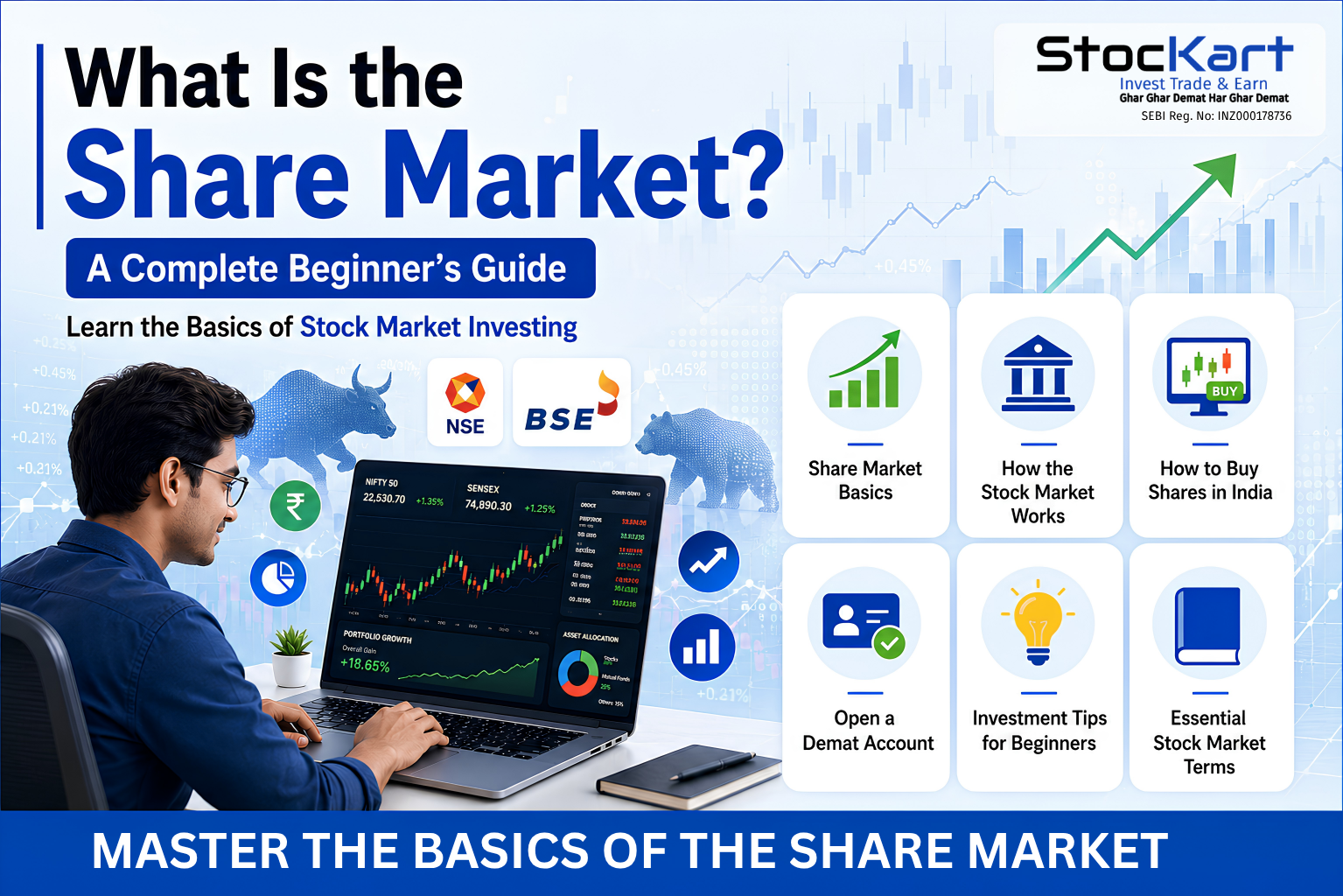
This StocKart share market guide for beginners explains everything you need to know—from what is the share market and how does it work to how to buy shares in India, how to open a Demat account, and practical investment tips for beginners.
Whether you're a student, a working professional, or someone planning to invest for the first time, this guide will help you understand the market in simple language.
What Is the Share Market?
The share market is a marketplace where investors buy and sell shares of publicly listed companies. A share represents a small ownership stake in a company. When you purchase shares, you become a shareholder and participate in the company's growth.
If the company performs well and its value increases, the price of your shares may rise. Some companies also distribute a portion of their profits to shareholders in the form of dividends.
In simple words, the share market explained in simple words is a place where businesses raise money for growth, and investors get an opportunity to earn returns by investing in those businesses.
Share Market vs Stock Market: What's the Difference?
Many beginners use the terms share market and stock market interchangeably, and in most cases, that's perfectly fine. However, there's a slight difference.
| Share Market | Stock Market |
|---|---|
| Focuses mainly on buying and selling company shares. | Includes shares, ETFs, bonds, REITs, and other securities. |
| Refers specifically to equity investments. | Covers a wider range of financial instruments. |
For most retail investors, both terms refer to investing in publicly listed companies.
In India, trading takes place primarily on the National Stock Exchange (NSE) and the Bombay Stock Exchange (BSE), which operate under the regulations of SEBI (Securities and Exchange Board of India).
What Is Share Market and How Does It Work?
One of the most common questions beginners ask is, "What is share market and how does it work?"
Here's a simple explanation.
Step 1: A Company Raises Capital
When a company wants to expand its business, launch new products, or reduce debt, it may raise money by offering shares to the public through an Initial Public Offering (IPO).
Step 2: Shares Are Listed on a Stock Exchange
After the IPO, the company's shares are listed on stock exchanges such as NSE and BSE, where investors can buy and sell them.
Step 3: Investors Trade Shares
Investors purchase shares through a registered stockbroker using a Trading Account and hold them electronically in a Demat Account.
Step 4: Share Prices Change
Stock prices move continuously based on demand and supply.
For example:
If more investors want to buy a company's shares, the price generally increases.
If more investors sell than buy, the price usually declines.
Several factors influence share prices, including:
Company earnings
Business growth
Economic conditions
Interest rates
Inflation
Government policies
Global events
Investor sentiment
Understanding how the share market works helps you make informed investment decisions instead of relying on rumours or emotions.
Basics of the Share Market Every Beginner Should Know
Before investing, it's important to understand the basics of the share market.
1. Share
A share represents partial ownership in a company. The more shares you own, the larger your ownership stake.
2. Stock Exchange
A stock exchange is a regulated marketplace where investors buy and sell securities.
India has two major stock exchanges:
National Stock Exchange (NSE)
Bombay Stock Exchange (BSE)
3. Demat Account
A Demat Account stores your shares electronically. It eliminates the need for physical share certificates and makes investing secure and convenient.
4. Trading Account
A Trading Account is used to place buy and sell orders in the stock market.
5. Stockbroker
A stockbroker is a SEBI-registered intermediary that provides access to the stock market.
If you're planning to invest, StocKart offers a simple and beginner-friendly platform where you can open a free Demat account, invest in stocks, apply for IPOs, and manage your investments with ease.
6. Dividend
A dividend is a portion of a company's profits distributed to its shareholders.
7. Market Capitalization
Market capitalization, or market cap, is the total market value of a company's outstanding shares. Companies are generally classified as:
Large-cap
Mid-cap
Small-cap
Each category has different risk and return characteristics.
Why Do Companies List Their Shares?
Companies choose to list on the share market for several reasons:
Raise funds for business expansion
Develop new products and services
Enter new markets
Reduce debt
Improve brand visibility
Increase credibility
Provide liquidity to early investors
Listing benefits both businesses and investors. Companies receive capital for growth, while investors get an opportunity to participate in their success.
Why Do People Invest in the Share Market?
The share market has become one of the most popular investment avenues because it offers the potential to create wealth over the long term.
Some of the biggest benefits include:
Wealth Creation
Historically, equities have outperformed many traditional investment options over long investment horizons.
Inflation Protection
As the cost of living rises, investing in quality businesses can help your money grow faster than inflation.
Dividend Income
Many established companies reward shareholders by distributing a portion of their profits.
Liquidity
Unlike some investments, shares can generally be bought or sold during market hours.
Ownership
Buying shares makes you a part-owner of a company, allowing you to benefit from its future growth.
Who Should Invest in the Share Market?
Almost anyone with long-term financial goals can invest in the stock market.
It is suitable for:
Students starting their investment journey
Salaried professionals
Business owners
Self-employed individuals
Young investors
Long-term wealth builders
Retirement planners
The key is to invest according to your financial goals, risk tolerance, and investment horizon.
Is the Share Market Safe for Beginners?
Yes—provided you invest wisely.
Many people believe the stock market is only for experts, but that's a misconception. Beginners can invest safely by:
Learning the basics before investing
Starting with financially strong companies
Diversifying investments
Avoiding rumours and tips
Investing for the long term
Reviewing investments periodically
Remember, the biggest risk isn't market volatility—it's investing without understanding what you're buying.
At StocKart, we encourage investors to focus on education before making investment decisions. A well-informed investor is better equipped to navigate market ups and downs.
Coming Up Next
In the next part of this guide, you'll learn:
How to start investing in the share market
How to buy shares in India
Share market investment tips
Essential stock market terms for beginners
Common investing mistakes to avoid
Frequently Asked Questions
Final investment checklist
Why choose StocKart for your investment journey